Going Burger King dairy free in the UK is genuinely possible, but it takes knowing which items are naturally free from milk as a declared ingredient versus which only carry a cross-contact risk — and which need a simple modification to work. This guide walks through all three categories using our own tracked allergen data, so you know exactly what to order and what to ask staff to change.
“Contains Milk” vs “Cross-Contact Only” — Why the Difference Matters
This distinction is the single most important thing to understand before ordering burger king dairy free. Some items have milk as an actual declared ingredient — cheese, certain sauces, specific coatings. Others have no milk in the recipe at all, but are cooked on shared equipment (the flame grill, the fryer) alongside items that do contain dairy, creating a possible trace risk rather than a certainty. For a lactose intolerance, cross-contact items are usually fine. For a genuine milk allergy, that distinction matters a great deal more, and it’s covered in full in our milk allergen breakdown.
Naturally Dairy-Free Items (No Milk Declared)
These items don’t list milk as an ingredient at all — cross-contact is still possible on shared equipment, but nothing here has dairy built into the recipe itself.
Items That Need a Simple Modification
Several popular items become dairy-free with one straightforward change at the till or in the app.
Most modifications like these can be made directly in the BK app’s customisation options, which tends to be more reliable than asking verbally during a busy period. The full Burger King Menu UK guide covers every item if you want to check a specific build before ordering.
Items That Contain Milk as a Declared Ingredient (Avoid)
Dairy-Free Sides
Sides are one of the easier categories to get right, since most of the range doesn’t involve cheese or cream-based ingredients.
For the complete current range beyond what’s listed here, our dairy-free sides breakdown covers every side on the menu in full.
FAQs — Burger King Dairy Free
Is Burger King’s regular Hamburger dairy-free?
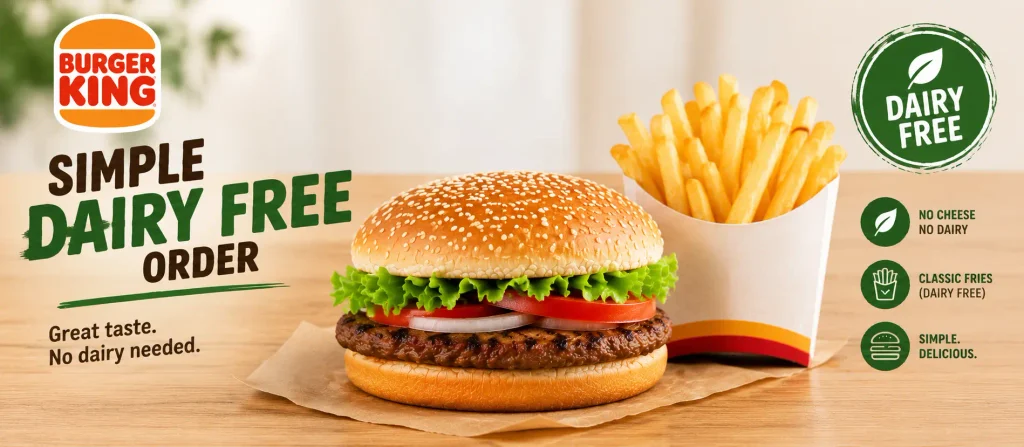
Yes, without cheese — milk isn’t a declared ingredient, though cross-contact from shared grill equipment is possible.
Are Burger King fries dairy-free?
Yes, as an ingredient — milk isn’t declared, but fries are cooked in a shared fryer, so cross-contact is possible.
Can I get a cheeseburger without cheese to make it dairy-free?
Yes — removing cheese is a straightforward request either at the counter or through the app’s customisation options.
Are Burger King’s plant-based items automatically dairy-free?
Not guaranteed — they’re cooked on shared grill equipment alongside dairy-containing items, so cross-contact is possible even though the declared recipe itself doesn’t include milk.
Does Burger King UK label dairy-free items clearly on the menu?
Not with a specific “dairy-free” label — you need to check individual allergen information for milk specifically, which is what this guide is built to simplify.
Final Thoughts — Burger King Dairy Free
Eating Burger King dairy free in the UK is realistic once you know which items to trust as-is, which need one simple modification, and which to avoid outright. For anyone managing a genuine milk allergy rather than a dietary preference, the cross-contact distinction covered above matters more than the ingredient list alone.
One Response