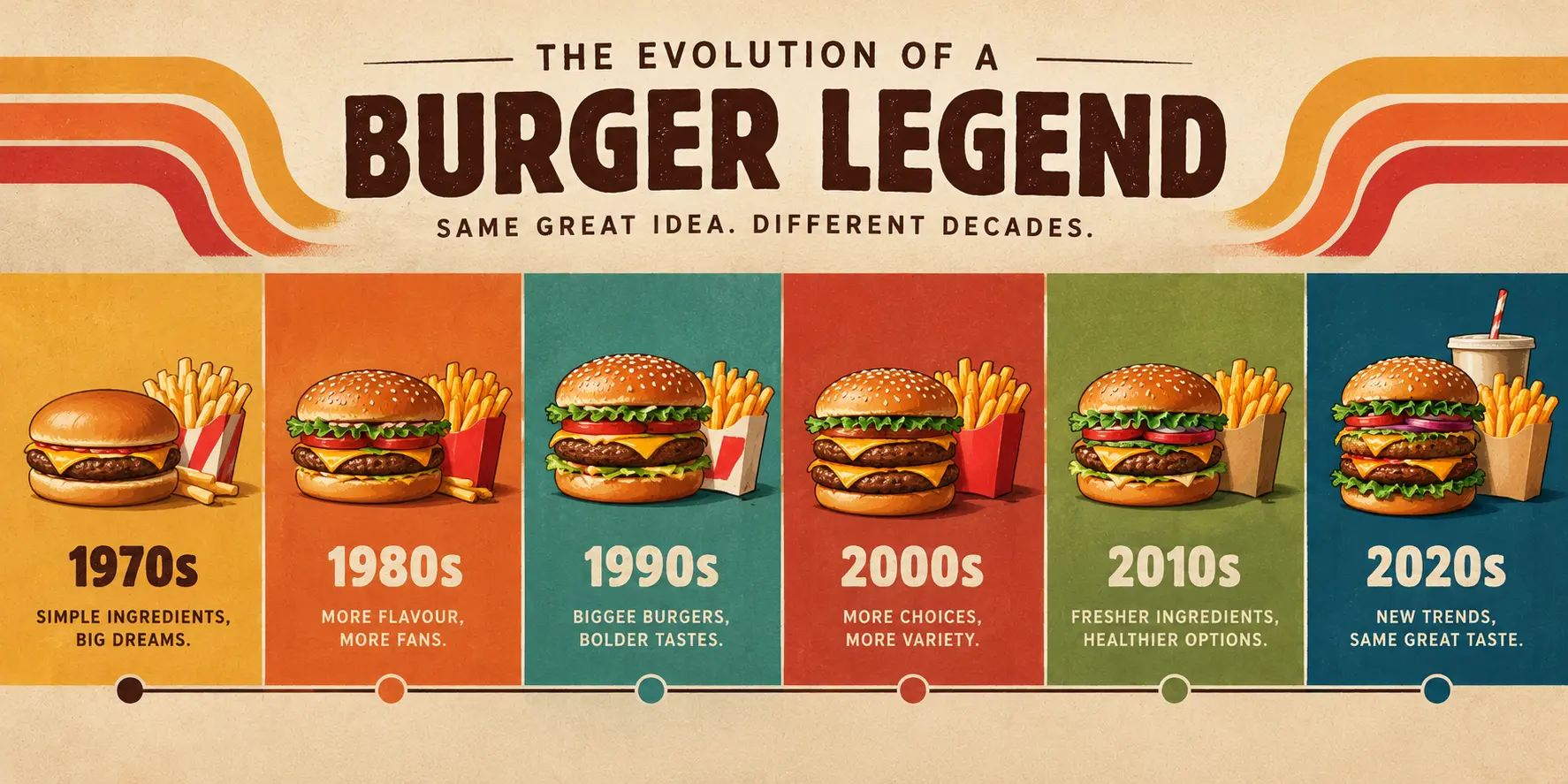
Burger King UK history stretches back nearly fifty years, from a single central London restaurant to a nationwide chain with hundreds of branches. This post walks through the key dates, ownership changes and menu milestones that shaped the brand as we know it today.
If you’ve ever wondered when the first UK branch opened, how it grew through the Wimpy years, or what happened during the 2013 horsemeat scandal, this is the full timeline — including where different published sources disagree on exact dates.
When Did Burger King Arrive in the UK?
Most published accounts agree that Burger King first entered the UK market in 1976, with the first physical restaurant opening on Coventry Street in central London the following year. A handful of sources give 1975 instead, so treat the exact year as approximate rather than fixed — but the mid-to-late 1970s window is well established across independent write-ups of Burger King UK history.
That first restaurant served a fairly simple range by today’s standards: the Whopper, fries, milkshakes and apple pies. Early newspaper reviews from the period were mixed at best, with reports of unclean premises and underwhelming burgers — a reminder that even now-familiar brands had rocky starts.
The 1980s: Slow Expansion and the Wimpy Connection
Growth through the early 1980s was gradual. A second restaurant opened outside London, in Luton, in 1981, and the chain expanded steadily through the decade rather than explosively.
The real turning point in Burger King UK history came in 1989, when around 150 Wimpy restaurants across the UK were converted into Burger King branches. This single event did more to expand the brand’s physical footprint than anything before it, and it set the pattern for how Burger King would keep growing in the UK: less about opening brand-new sites from scratch, and more about converting existing restaurant real estate.
The 1990s: From 250 Branches to Nearly 500
The 1990s were the chain’s fastest-growing decade. The table below shows how quickly the branch count climbed once the Wimpy conversions took hold.
The pattern here is consistent: almost every major jump in branch numbers lines up with a conversion deal — Wimpy sites in 1989, then motorway services and Little Chef sites through the mid-1990s — rather than a wave of new-build restaurants.
By 1999, Burger King held roughly 15% of the UK’s burger restaurant market, a position it had built in barely a decade — arguably the fastest-growing chapter in Burger King UK history. For a broader sense of how the brand’s current UK footprint compares, this Burger King menu resource rounds up what’s on offer at branches today.
The 2000s and 2010s: A Quieter Period, Then a Scandal
After the rapid 1990s growth, the 2000s and early 2010s were a quieter chapter of Burger King UK history — a long stretch without the dramatic expansion of the previous decade.
That changed for the wrong reasons in 2013, when Burger King’s own supplier investigation found trace amounts of horsemeat DNA in beef products used in some UK restaurants, as part of the wider European horsemeat scandal that also affected other retailers and food brands that year. Burger King responded by switching supplier and publicly confirming the results of its testing.
2017 Onwards: A New Ownership Structure and Renewed Growth
A significant shift in Burger King UK history came in 2017, when investment firm Bridgepoint acquired the master franchise agreement for the UK, taking direct ownership and management of an initial 74 restaurants while the remainder continued as sub-franchises. This restructuring is widely reported as the point where the brand’s UK growth picked back up after years of relative stagnation.
Since then, the chain has kept expanding its physical footprint and refreshing its menu more frequently, including limited-time collaborations and seasonal ranges. You can keep track of what’s currently on offer, plus any new openings, via latest Burger King news on this site.
Burger King UK Today: How Many Restaurants Are There?
As of the most recently published figures (June 2022, via the British Franchise Association), Burger King UK operated around 533 restaurants, with roughly half directly owned and the rest run as sub-franchises. More recent totals are sometimes quoted at “around 500”, which is consistent with that figure allowing for normal openings and closures since.
Restaurant counts like these are always a snapshot rather than a fixed number, since openings and closures happen throughout the year, so any single figure only tells part of the wider Burger King UK history. If you’re after a current, item-by-item look at what’s actually being served in UK branches right now rather than a historical count, the full current menu on this site is kept up to date separately from this history piece.
FAQs
When did Burger King open its first restaurant in the UK?
Most sources place the first UK restaurant’s opening in 1977, on Coventry Street in central London, with Burger King having entered the UK market the year before, in 1976 — the starting point most write-ups of Burger King UK history use. A small number of sources give 1975 instead, so this date is best treated as approximate rather than exact.
How did Burger King UK grow so quickly in the 1990s?
Largely through converting existing restaurants rather than building new ones — around 150 Wimpy branches became Burger King in 1989, followed by motorway service sites and converted Little Chef restaurants through the mid-1990s, taking the UK branch count from 250 in 1994 to 465 by 1997.
Was Burger King UK involved in the 2013 horsemeat scandal?
Yes. Burger King’s own supplier testing found trace amounts of horsemeat DNA in some beef products in 2013, part of a wider scandal that affected several UK food brands and retailers that year. The company changed supplier in response.
Who owns Burger King UK now?
Since 2017, investment firm Bridgepoint has held the master franchise agreement for the UK, directly owning and managing a portion of restaurants while the rest operate as sub-franchises under other operators.
How many Burger King restaurants are there in the UK?
The most recently published figure, from the British Franchise Association in June 2022, puts the total at around 533 UK restaurants, split between directly owned and sub-franchised sites.
Final Thoughts
Burger King UK history is really a story of growth by conversion — Wimpy sites, motorway services, Little Chef restaurants — punctuated by one major supplier scandal and a 2017 ownership restructuring that set up the chain’s current shape. Nearly fifty years on from that first Coventry Street restaurant, it remains one of the UK’s most recognisable fast food brands, even as the exact figures from its early decades vary slightly depending on which source you check.
One Response