If you’ve ever stood at the counter wondering exactly what “may contain” means, or why a burger you’ve eaten a hundred times suddenly lists a new allergen, this guide on Burger King allergens explained is for you. UK law requires every food business, fast food chains included, to declare a specific list of 14 allergens for anything sold to the public, and that legal framework shapes everything from the in-store leaflets to the filters inside the ordering app.
This post breaks down what the 14-allergen label actually covers, how Burger King UK communicates that information across different ordering channels, and where cross-contact risk genuinely matters versus where it’s overstated. It’s written for anyone managing a food allergy or intolerance who wants a clear, honest answer rather than a wall of small print.
What “14 Allergens” Actually Means Under UK Law
Getting burger king allergens explained properly starts with one key fact: the phrase “14 allergens” isn’t a Burger King policy — it’s a legal requirement. Under UK food information regulations (built on the same framework as the EU’s Food Information for Consumers rules), any business serving food to the public must clearly identify 14 specific allergenic ingredients whenever they’re used in a recipe. This applies equally to a Michelin-starred restaurant and a fast food counter, so the list itself is standardised across the entire industry rather than something any single brand invented.
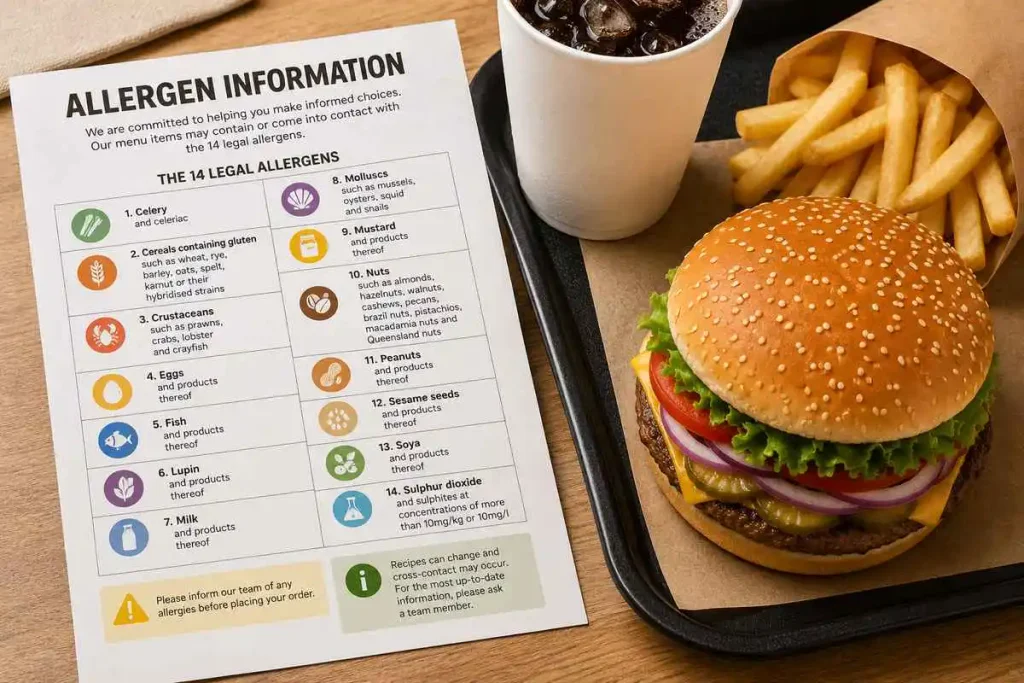
The Full List of 14 Allergens
The full list below is central to burger king allergens explained accurately, since these are the exact categories UK law requires businesses to disclose. Before ordering with any food allergy or intolerance, it helps to know exactly which substances the law requires businesses to flag. The table below lists all 14 categories along with a few everyday examples of where each one turns up on a typical fast food menu.
Two things stand out once you see the full list side by side: sesame and cereals containing gluten show up almost everywhere because of the bun, and several allergens that sound obscure — lupin, molluscs, sulphites — appear rarely enough that they’re easy to overlook if you’re only scanning for the “big” ones like nuts or dairy.
How Burger King UK Labels Allergens (In-Store and Online)
Part of getting burger king allergens explained clearly means understanding exactly where that information reaches customers. In practice, it comes through three main channels: a printed folder or laminated sheet available on request in-store, the nutritional and allergen pages on the website, and filters built into the ordering app. None of these replace each other — the printed in-store version is usually the most current for last-minute recipe or supplier changes, while the digital versions are easier to check in advance. If you want to see how every menu item maps against all 14 categories in one place, our own full 14-allergen table lays it out item by item so you’re not relying on memory at the counter.
It’s also worth remembering that allergen data can change when a supplier swaps an ingredient, so checking shortly before you order is safer than relying on a visit from a few months ago. This is one of the areas where staying current matters more than almost anything else on a fast food menu, which is exactly why the allergen page gets rechecked and updated separately from general menu content on this site.
Cross-Contact Risk You Should Know About
Cross-contact is different from an allergen actually being a recipe ingredient. Fryers are frequently shared between products — meaning fries cooked in the same oil as a breaded chicken item can pick up trace gluten or other allergens even if the fries recipe itself doesn’t contain them. Grills, prep surfaces and utensils can carry similar risk during a busy shift. For a genuine allergy (rather than a mild intolerance), this distinction matters enormously, and it’s worth asking a team member directly about fryer and grill sharing rather than assuming a “gluten-free” listed item is risk-free for someone with coeliac disease.
Common Mistakes People Make Reading Allergen Labels
A big part of burger king allergens explained well is clearing up recurring misunderstandings, most of which are easy to fix once you know what to look for.
- Confusing “Contains” with “May contain.” “Contains” means the allergen is a deliberate recipe ingredient. “May contain” is a precautionary cross-contact warning, and the two carry very different levels of risk for someone with a severe allergy.
- Assuming a swapped ingredient updates every channel at once. A recipe change might hit the in-store leaflet before the website catches up, or vice versa — always ask in person if anything seems inconsistent.
- Treating “gluten-free” as identical to “coeliac-safe.” A product can be free of gluten as a listed ingredient while still carrying cross-contact risk from shared equipment.
- Skipping sauces and dips. Sauces are one of the most common places for milk, mustard, egg and soya to hide, and they’re easy to overlook because they feel like an afterthought rather than “the food.”
Allergens and Specific Diets: Where to Go Next
Allergen information overlaps heavily with other dietary questions, and it’s worth treating them as related but separate checks rather than assuming one covers the other. If your priority is calorie or macro tracking rather than allergy management, our full nutrition guide breaks every item down by calories, protein, fat and carbs, item by item, so you’re not cross-referencing two different systems in your head. Similarly, if gluten is your specific concern, our full gluten-free guide goes further than the general allergen table and focuses specifically on cross-contact risk for coeliac and gluten-sensitive diners.
If you’re building an order around lower-allergen sides rather than the core burgers, the full sides menu is worth a look too, since side dishes tend to have simpler, shorter ingredient lists than the mains. And whenever you want to jump back to see the current menu in full rather than just the allergen slice of it, our homepage always links out to the latest version.
Practical Tips for Ordering Safely
Turning burger king allergens explained information into practice comes down to a handful of habits, more than any single piece of knowledge.
- Check before you queue, not while you’re in it. Look up the item on the allergen table or app filter before you’re at the counter under time pressure.
- Say the allergy out loud, every time. Staff are trained to flag cross-contact risk when asked directly, but they can’t act on information they don’t have.
- Re-check items you order regularly. Recipes and suppliers change more often than most people expect, especially around limited-time menu launches.
- Ask about fryer and grill sharing specifically, not just about ingredients — this is where most preventable cross-contact happens.
- When in doubt, ask for the printed allergen folder. It’s often the most current version available in the moment.
FAQs
To round out this look at burger king allergens explained, here are the questions that come up most often.
Does Burger King UK actually publish full allergen information?
Yes. UK law requires it for all 14 regulated allergens, and the information is available in-store on request, through the website, and via the ordering app.
Are Burger King fries gluten-free?
The fries recipe itself is typically free of gluten as an ingredient, but shared fryer oil with breaded products can introduce cross-contact, so anyone with coeliac disease should ask staff about fryer sharing before ordering.
What’s the difference between an allergy and an intolerance for ordering purposes?
An allergy can trigger a serious immune reaction from even trace amounts, which makes cross-contact risk critical, while an intolerance is generally about ingredient quantity and digestive comfort rather than trace exposure.
Does the app let you filter by allergen?
Most major fast food ordering apps, including Burger King’s, include some form of allergen filtering, though the depth and accuracy of the filter can vary, so it’s worth treating it as a starting point rather than a final word.
How often does allergen information change?
It can change whenever a supplier or recipe changes, which happens more frequently than most customers assume — this is why checking shortly before ordering is safer than relying on a past visit.
Final Thoughts
That’s burger king allergens explained in practical terms rather than legal jargon. The 14-allergen label isn’t Burger King-specific small print — it’s a legal standard that applies across the entire UK food industry, and understanding how it works makes ordering safer regardless of where you eat. The practical takeaway is simple: treat “Contains” and “May contain” as genuinely different warnings, ask about cross-contact rather than just ingredients, and re-check before ordering rather than relying on memory from a previous visit. None of this makes eating out with a food allergy risk-free, but it does make it a much more informed decision.